Fundamentals of Paragraph Writing Strategy
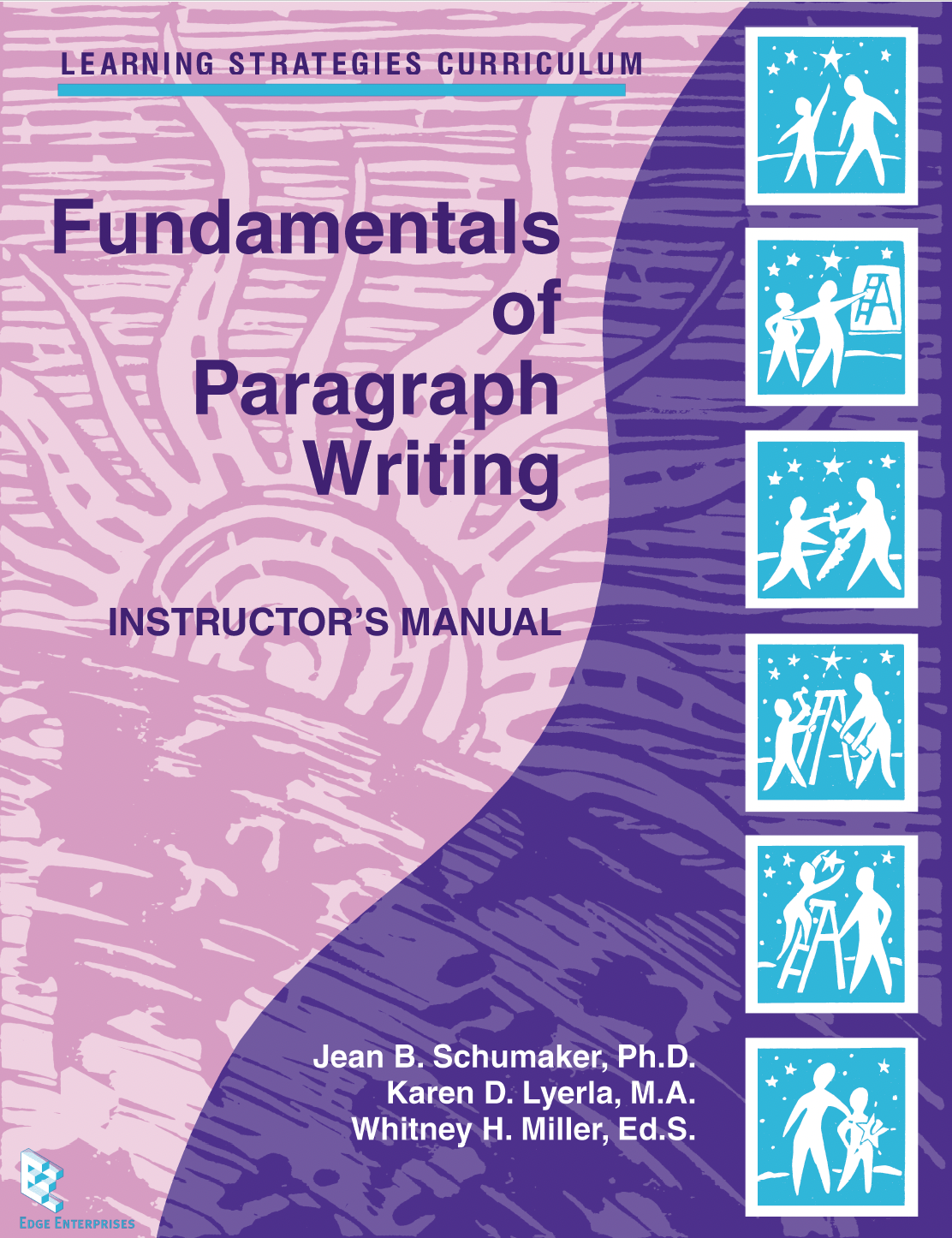
This Fundamentals of Paragraph Writing Strategy was designed for and field tested with students in grades 2 through 6. It can be used in general and special education classes. The instructor’s manual covers instruction in all the basic components of a paragraph, including verb tense, point of view, transitions, topic sentences, detail sentences, and clincher sentences. It also covers three fundamental types of paragraphs, including descriptive, narrative, and persuasive paragraphs. Each of these concepts is covered using the lesson format, with one lesson per concept.
Accompanying the instructor’s manual is an online website with instructional resources, including: cue cards, notes sheets, learning sheets, score sheets, progress charts, management charts, PowerPoints, and teacher-designed documents that can be used to support instruction. These materials correspond to the lessons in the instructor’s manual. They can be copied and used as needed for instructing students in the program. Instruction in the Fundamentals in the Sentence Writing Strategy is highly recommended before using this program. Students should be able to write and check complete sentences before beginning this program.
Author(s): Jean B. Schumaker, Karen D. Lyerla, Whitney H. Miller
Publication and Purchasing Information visit: Edge Enterprises Inc. https://edgeenterprisesinc.com/product/fundamentals-of-paragraph-writing-instructors-manual/
Research:
The Fundamentals of Paragraph Writing program was field tested in two 6th grade classrooms. These were inclusive classes in which some students with disabilities were enrolled. Thirty-three students took both the pretest and posttest. Seven of them had been given a diagnosis requiring special education services. All of the students took the pretest before they began instruction in Fundamentals in the Sentence Writing Strategy program. They took the posttest after they participated in that sentence-writing instruction plus instruction in the Fundamentals of Paragraph Writing. For the pretest and posttest, they were asked to write a paragraph containing eight sentences in response to a prompt. A different prompt was given for the pretest versus the posttest.
During the pretest, the whole group of students wrote an average of 3.8 complete sentences. During the posttest, they wrote an average of 6.4 complete sentences. During the pretest, they attempted an average of 5.03 sentences. During the posttest, they attempted an average of 8.6 sentences. Thus, the number of sentences they attempted to write and the number of complete sentences increased.
The results for the students with disabilities also represented gains. They wrote an average of 4 complete sentences during the pretest and an average of 6 complete sentences during the posttest. They attempted an average of 5 sentences on the pretest and 8.2 sentences on the posttest. Thus, all the students were attempting to write more sentences, and more of their attempted sentences were complete.
With regard to paragraph organization, the whole group of students earned an average of 19 points on the pretest and 32 points on the posttest out of a total of 50 points. On the pretests, their scores ranged from 4 points to 38 points. On the posttests, their scores ranged from 18 to 50 points out of 50 points. The students with disabilities had similar results. They earned an average of 19 points for paragraph organization on the pretest and an average of 33 points on the posttest. Their pretest scores ranged from 12 to 26 points, and their posttest scores ranged from 18 to 50 points out of 50 points.
Again, these scores represent an improvement after the students had only one chance to write a practice paragraph before they took the posttest. The school year ended and further instruction and practice activities were not possible.
There are multiple products associated with this strategy. Instructor and Student materials are published by Edge Enterprises, Inc.
Please note that professional development, coaching, and infrastructure support are essential components to effective implementation of SIM instructional tools and interventions. It is highly recommended that you work with a SIM professional developer.
An accessible version of the documents on this site will be made available upon request. Please contact the KU CRL Professional Development Research Institute, at simpd@ku.edu to request the document be made available in an accessible format.